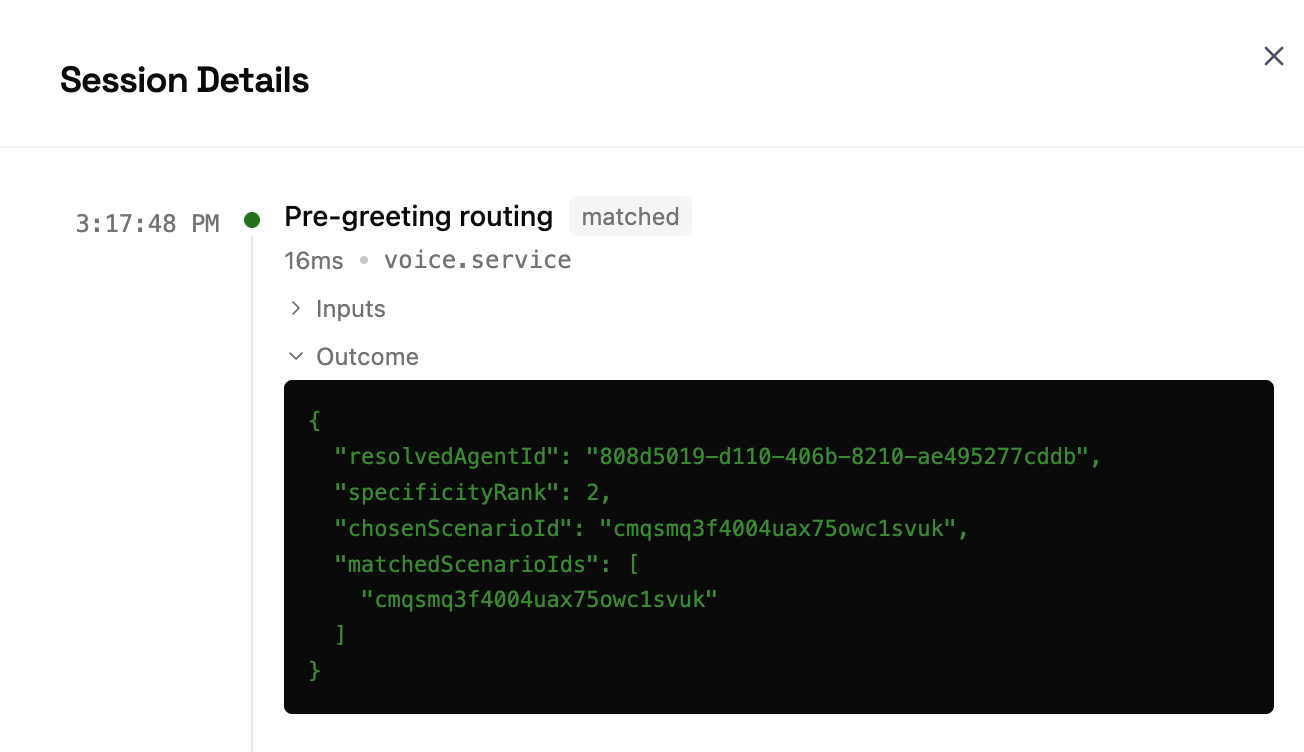
The AI knows what the call is about — before it picks up.
- Pre-greeting routing: Route calls from known contacts to the right scenario before the first word is spoken. We can filter by property, group type, or time of day so that the moment a call connects, we can swap to a custom greeting and set of agent rules.
- Memory upgrades continued: More memory upgrades to help your agent with skipping questions it already has the context on (such as the caller's name, if that's in their CRM profile or they previously shared it with us). Additional rules provide a framework for maintaining information guardrails while improving user experience for when to skip, when to confirm, and when to always ask again for critical information.
More accurate transcriptions.
- Context-driven transcriptions: With an upgraded speech-to-text model, we now can reference what the caller previously said, as well as what the agent said to them, to inform transcriptions—so easy-to-confuse words like "leasing" and "leaving" are anchored in context of the conversation. This upgrade is a first-of-its-kind model that has delivered meaningful accuracy improvements in testing.
- Language switching between English and Spanish: More resilience and training has been added to know when a caller is truly expecting to speak in another language to prevent accidental switching. Now, we enforce full phrase or specific request.
Outreach AI scales out.
- Build your own outreach agents: Super now allows you to set your own custom triggers for outreach agents. These can be triggered via webhooks so that you can have custom agents for each trigger you define.
- Voicemail detection 2.0: We've continued to refine voicemail detection, with a new hybrid approach leveraging temporal and heuristic evaluation to determine whether the caller answered or we've reached a voicemail greeting.
Under the hood
Many quiet wins that make everything else sturdier:
- Set the phone tree by role: Assign a call order to your phone tree for each role with a simple drag-and-drop.
- Tracking handoff rules: Exports of individual call metrics now include a column for handoff rule, so you can see what was selected by call.
- Resilience against AI provider hiccups: More failovers have been added to processes so that when one AI model has a bad minute, Super's structured output requests move on to the next model—further reducing chances of downtime.
- Property matching by unit: More improvements and consistency on property matching at the unit level.
- AI transfer whisper messages get shorter, so you can get the key details and accept faster.
What to expect next
- More voicemail detection improvements: More graceful handling of the edge cases, carrier issues, or poor connections.
- More evaluation insights: The decision-tracing infrastructure that shipped with pre-greeting routing is preparing to power "why did Super do that?" views across the entire product — not just at the start of a call.
Looking to implement pre-greeting routing? Customers: fill out the form here.