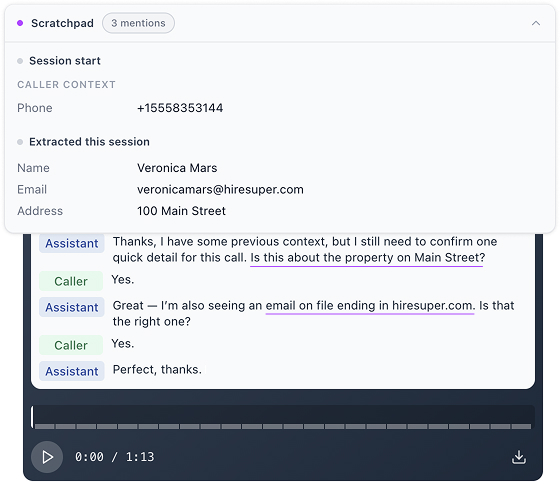
Agent memory put into action to confirm, skip, or ask key questions
- Last release, we implemented the building blocks for memory. Now, call memories can be more actively leveraged by your agent to reference information previously given or already available to personalize.
- The agent will confirm a known property or email, skip asking for name and caller group if we know it, and still ask when we need to fill in the blanks. The agent now intuits how to most seamlessly gather the information you need to proceed with that call.
Smarter property matching
- Property matching also applies to email subject lines.
- Addresses with apostrophes are normalized. Street names like "O'Brien" or property names like "Torrie's Towers" are retained during normalization, so the property match lands on the right place.
More prompt upgrades
- A customer-editable prompt is added to the first turn of the conversation. The persona you configure on an agent now consistently frames inbound calls.
- Silence re-prompts are dynamic. When a caller goes quiet, the AI now generates a context-aware re-prompt to sound more natural. If anything goes wrong on that path, the original static prompt is still there as a safety net.
Under the hood
These improvements don't change how you use Super, but they make everything more stable and accurate:
- Listing image URLs land in the right place. Synced listings whose image paths were relative now resolve to absolute URLs, so images render in every downstream view.
- Tone tuning on the universal call instructions. Small phrasing refinements so the AI doesn't over-prefer transferring to a person when it can resolve the conversation itself.
- Directory updates now cascade into actions even if staff and schedules are changed.
- All transfer timeline events are preserved even if the caller disconnects mid-transfer.
Watch our training video on how to utilize staff, roles, and scheduling.