Five reasons AI has moved from “interesting” to “operational”
Just a couple years ago, artificial intelligence in property management sounded experimental. But with the speed of development cycles in the age of AI, by 2026, it’s become core operating infrastructure.
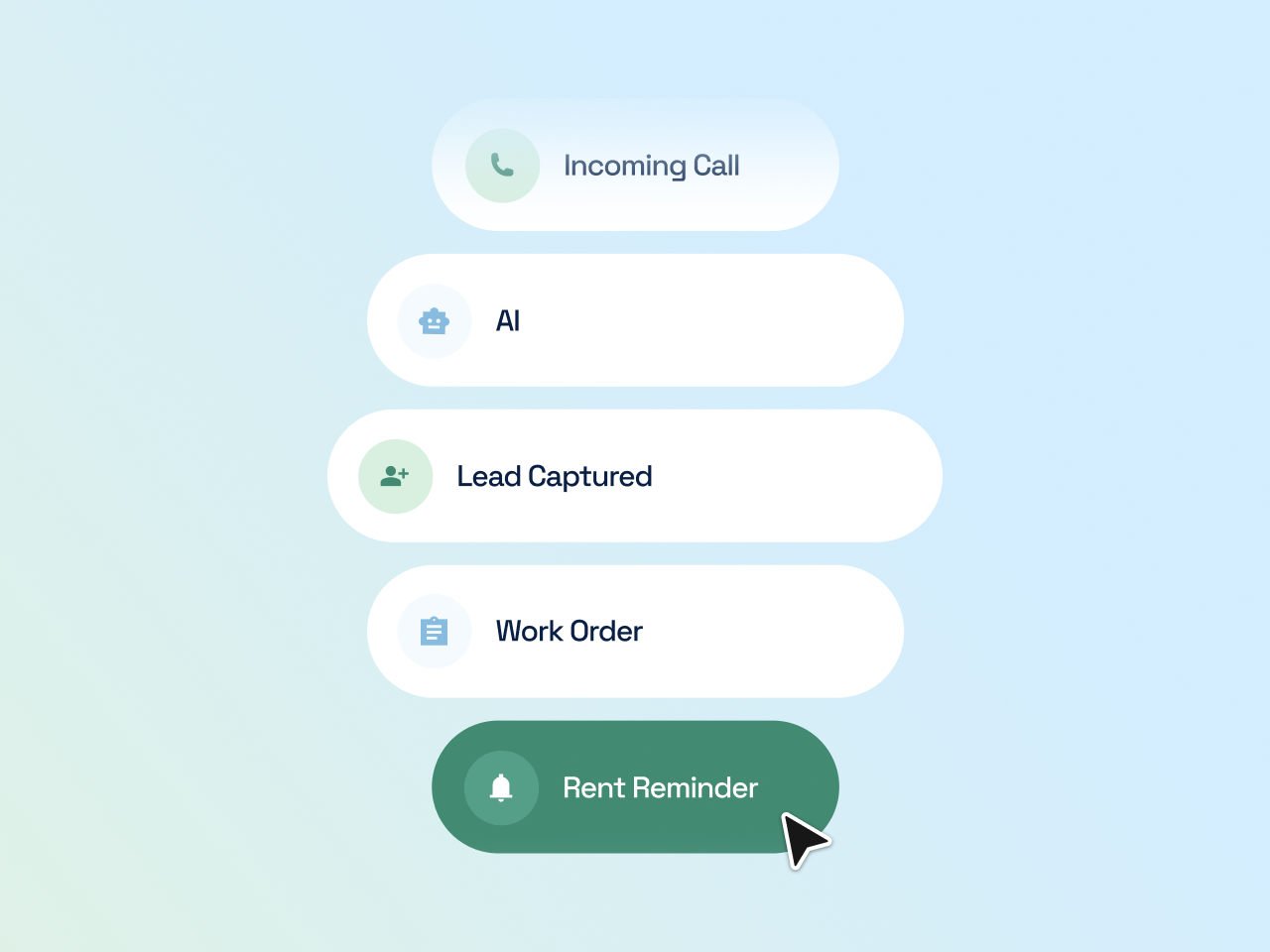
Property management companies are now using AI across various departments to to:
The key distinction: AI is not replacing property managers. It is removing repetitive operational drag.
Let’s break down exactly how AI is being used today.
1. AI Leasing Assistants
Leasing is where most revenue leakage happens.
Missed calls. Slow responses. Poor follow-up.
AI leasing systems respond instantly to:
How AI is solving leasing bottlenecks
Speed to lead is one of the biggest drivers of reduced vacancy. In competitive rental markets, responding within 60 seconds instead of 6 hours can be the difference between a signed lease and a lost opportunity. (Check out Super's AI outreach agent for calling leads right away.)
2. AI voice receptionists
Phone calls end up sucking up a lot of time for property managers — and many of those calls can be automated by AI.
AI voice agents can:
Unlike voicemail, AI interacts in real time. It knows when it needs to escalate, it can answer questions, and it avoids tedious phone trees while capturing information on the caller versus risking the hangup right away. See how Super's customers are utilizing AI voice to replace call center operations.
3. Maintenance triage and work order automation
Maintenance is one of the highest-volume communication channels in property management, and it is important to ensure these requests are handled appropriately. While a bulk of requests could just be a work order, sometimes troubleshooting can prevent it, and other times it's an emergency that needs more immediate attention. AI can help elegantly determine and input.
AI improves maintenance intake by:
This reduces back-and-forth communication and shortens dispatch time.
AI does not decide on major repairs — it organizes information so managers can act faster. (Did you know that Super can create work orders in several common property management softwares like Buildium, Rentvine, Rent Manager, and Appfolio? See all our integrations.)
4. Rent collection and late payment workflows
Late rent processes are often inconsistent and impersonal. They range from entirely automated emails with no humanity in them to no clear communication about why a fee was charged or when.
AI ensures:
The result is consistency without awkward manual follow-up.
5. Owner reporting and portfolio Insights
AI is a superstar when it comes to analyzing large amounts of unstructured data to formulate insights, generate reports, and distill themes. AI-led analysis can review portfolio data to surface trends like:
Rather than just presenting raw data, AI lets you perform analysis at scale to highlight operational risk areas and areas for improvement.
So... what is AI not best suited for?
AI does not do these tasks for property managers:
Use AI to handle structured workflows and SOPs with clear guidelines — not strategic, relationship-based decisions.
Why AI adoption is hitting the mainstream in 2026
Why is 2026 the year for AI adoption? We see four primary trends driving this:
For any property manager seeking to improve margins and resident relationships and reduce vacancy and overhead, AI solutions are now ready to help.
Final takeaway
AI in property management is not about automation for its own sake. It is about faster responses, consistent behavior and enforcement, reducing administrative workload, and a better tenant experience.
Firms that treat AI as an operational layer — not a gimmick — are gaining measurable advantage.
Ready to see how AI voice can help you gain an operational advantage? Book a demo today.